Surely, I have mentioned in this column that I’m not much of a planner when it comes to getting ready for boating trips large or small. In fact, planning trips is rather irritating to me. I don’t want to know what will happen each hour of the day or what restaurant I will go to when I get to a destination at an appointed time. I know people who plan trips to that level of detail, but it makes me feel a little crazy.
On the other hand, Tekla and I have decided that our summer destination this year on Sea Lab, our C-Dory 22, will be the Broughton Archipelago way up north in British Columbia. The thought of a trip such as this inspires a cascade of doubt and worry, to which I react with planning to minimize the risk of such an adventure. I’ve heard plenty of stories of big passages, bad weather, rough water, and fog. One friend who has been there a few times asked me, “Do you have radar? Don’t go there without radar!” Uh… no, I don’t have radar. Should I not go? Don’t be silly, it will be fine. Won’t it?
This line of reasoning prompts my chosen “planning” activity: a review of the maintenance log and an inspection of the boat and its systems (of which there are fortunately few) with a critical eye. Maintenance items sometimes pile up and are put off for whatever reason, and we have a few of those before we’re ready to set off this summer.
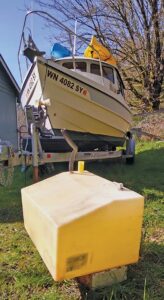
One issue that developed last year on our way home from Canada was a fuel leak during re-fueling. It was a puzzling problem and a high priority repair. The leak only occurred while we were filling the tanks with gasoline. The result was 2-3 tablespoons of fuel that worked its way into the small bilge, and the leak stopped after we were done filling the tanks. Sopping gas out of the bilge really made me miss my old one-cylinder diesel on Moondance, our last sailboat—man I loved that boat! I’m sure I am not alone about being wary of having gas on my boat. It took a couple re-fillings to figure out which tank was the culprit, and it turned out to be from the port tank. I checked everything I could while we were underway, but the space is cramped and dark and I really could not see where the gas could be coming from. We finished the trip using only the starboard tank. At some point in troubleshooting, I decided my only option was to pull the tank out so I could really get a good look in there, and that is where the project stopped and got put off for a more convenient time. I’ve been dreading that task for months.
The “more convenient” time arrived on the last weekend in March—two warm, sunny days in a row after several months of cold and wet. I steeled my attitude, gathered my tools, and went to work. I suspected that the only place it could be leaking is the one-and-a-half inch diameter rubber fill tube connecting the deck plate to the tank, though I could see no evidence that this was the case. Consulting the C-Brats online C-Dory forum for information, I found that other people had experienced this problem and nobody had a single positive thing to say about this job. One guy even said, “This is the worst job I’ve ever tried.” Tried was a word that bothered me. He didn’t say he actually completed the project, and I had visions of having to haul the boat into the shop half taken apart and ask them to fix it for me.
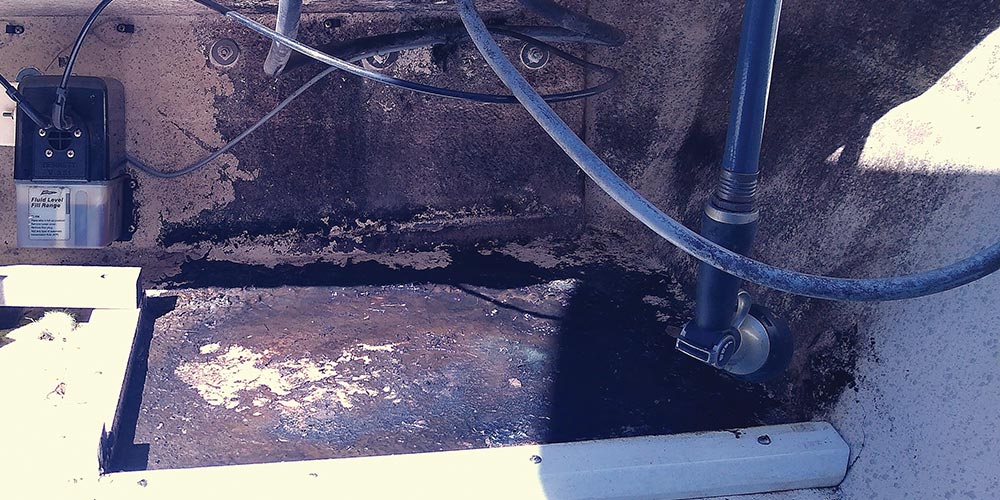
I took some “before” pictures and dove in. Those C-Brats were right, it wasn’t easy. Loosening all the hose clamps went ok—they were more or less accessible—but getting hoses off the barbs was tough in that cramped space. The fill tube is remarkably inflexible and goes through a small space at the bottom of a gunwale storage area. I wrestled it out and pulled the tank. When I lifted it, I encountered a layer of disgusting black goo underneath, it broke apart with a putty knife and it did not smell very good.
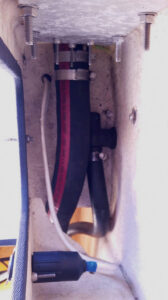
A couple hours of cleaning felt good and, eventually, the space where the tank goes looked great. I inspected the fill hose to see if I could detect the problem. Holding the open end of the hose up to bright sunlight I could see three small cracks in the lining that I had not been able to see when I just shined a flashlight in there. These cracks weren’t much, but they were in the right spot to cause leakage if they were the culprit.
A quick run to Belfair’s May Mobile Marine scored me 20 ¾ inches of ABYC Coast Guard approved, wire reinforced, highly inflexible rubber hose. Arriving home, I placed the hose on top of the trailer’s spare tire to relieve some of its inflexibility in the warmth of late winter sun.
The only thing left to do now was to reassemble, so I got busy reversing the process. Lo and behold, everything went together more easily than it came apart. I straightened my old frame out of my cramped position and gave myself a high five as my pessimism evaporated, at least temporarily. I feel about 75% confident the problem is resolved, though I won’t know for sure until we relaunch and make a fuel run. I’m keeping my fingers crossed.
There are a dozen or so other things that I am planning to take care of to keep us safe and comfortable on our little vessel for what will be our longest voyage so far. Though I’m still not going to plan our route or make reservations anywhere. Sure, I’ll look at where fuel, water, and supplies can be found along the way and duly make note of those locations on the charts, but preparing the boat to be safe is the crux of my planning. The rest of the trip will come down to being present where we are, and resourceful while getting there. I’ll let you know how it turns out!
Dennis, Tekla, and Tim Tim the sailor dog recently changed their home cruising waters from Tacoma to Case Inlet.